Description
What is a MEWP scissor lift?
A mobile elevating work platform, commonly known as a MEWP, is designed to provide temporary access to elevated working areas.
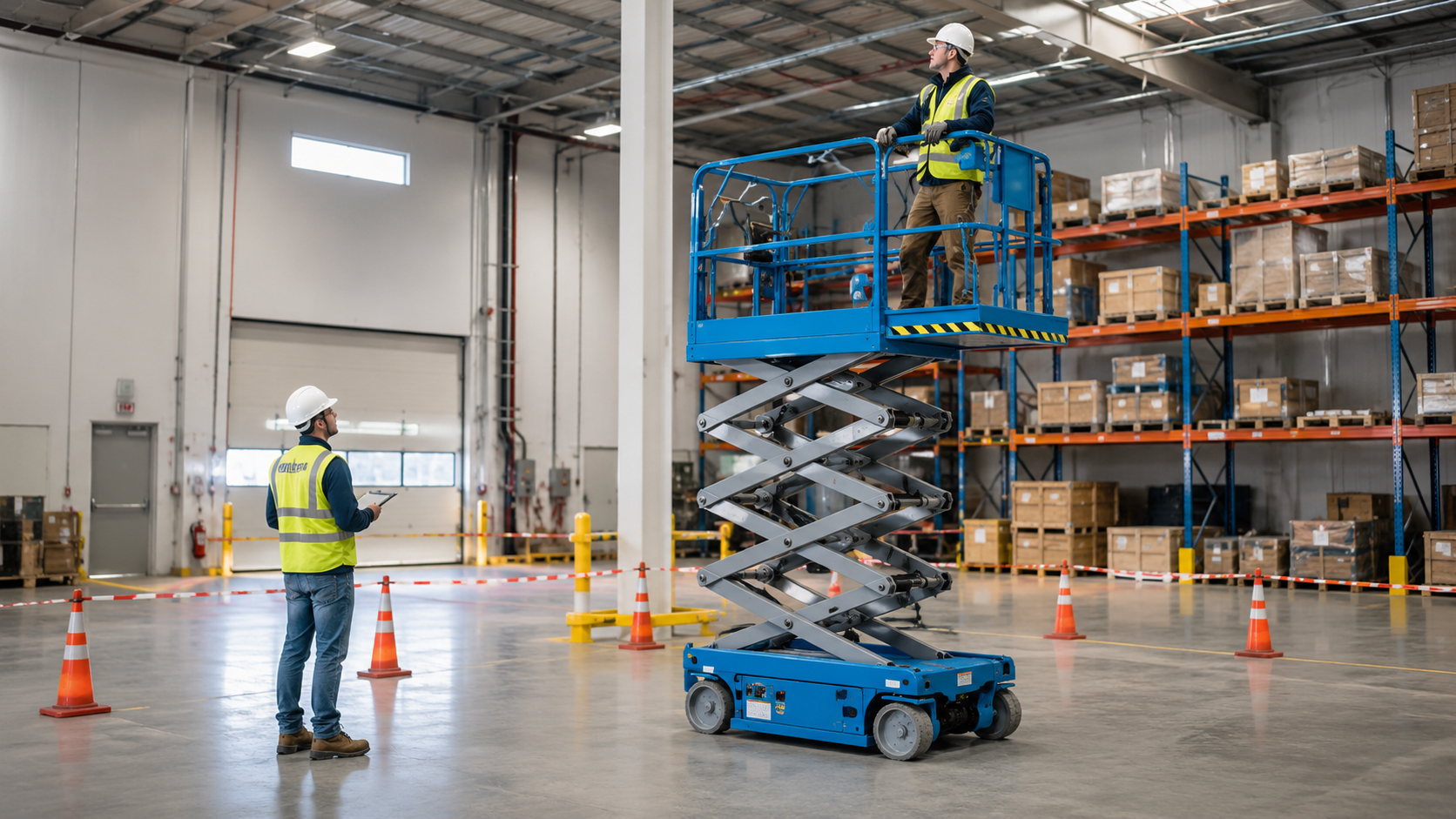
A scissor lift uses a folding support structure to raise and lower its working platform vertically. Scissor lifts are commonly used in construction, warehousing, facilities management, maintenance, electrical installation and other industries where employees need to work safely at height.
Because incorrect operation can result in falls, overturning, trapping or collisions, anyone operating a scissor lift must receive suitable training and demonstrate that they can use the equipment safely.
Course objective
The purpose of the course is to provide learners with the practical operating skills and safety knowledge needed to prepare, operate and shut down a MEWP scissor lift correctly.
On completion of the course, learners should be able to:
- Understand the operator’s responsibilities and the hazards associated with working at height
- Identify the principal components of a scissor lift and explain their functions
- Locate and identify the steering, driving and braking controls
- Follow the manufacturer’s operating instructions
- Complete the required pre-use and operational checks
- Check the emergency lowering controls
- Mount and dismount the platform safely
- Configure the machine correctly for travel
- Manoeuvre safely on level ground and suitable inclines
- Operate within open and confined areas
- Identify overhead, ground-level and underground hazards
- Assess the suitability and condition of the working area
- Position and configure the machine for an access task
- Raise and lower the platform safely
- Complete work tasks at different operating heights
- Travel with the platform raised where permitted
- Operate the platform-extension section where fitted
- Follow safe parking and shutdown procedures
- Understand the requirements for loading and unloading the machine for transport
Course content
The course combines theoretical instruction with practical training and assessment. Subjects covered include:
- Health and safety legislation
- Working-at-height responsibilities
- Types and uses of mobile elevating work platforms
- Manufacturer’s instructions and operator manuals
- Machine controls and safety devices
- Pre-use inspections
- Emergency lowering procedures
- Ground and workplace conditions
- Overhead obstructions and other hazards
- Safe travelling and manoeuvring
- Correct platform positioning
- Raising and lowering the platform
- Stability and safe working limitations
- Parking, isolation and shutdown procedures
- Theory and practical assessments
Course duration
The course duration depends on the learner’s previous experience, ability and the number of candidates attending.
A typical NPORS N109 MEWP Scissor Lift course takes one day, including theoretical instruction, practical training and assessment.
Experienced operators may undertake a shorter training or assessment route where appropriate. Learners must have sufficient current operating experience to qualify for an experienced-worker test.
Contact SB Skills before booking so we can recommend the most suitable course route.
Entry requirements
The course is open to novice and experienced operators.
Learners should:
- Be physically capable of operating the equipment safely
- Have an appropriate level of literacy and understanding for the course
- Bring acceptable photographic identification
- Wear the required personal protective equipment
- Inform SB Skills of any additional learning or support requirements before attending
Candidates applying for an NPORS card carrying the CSCS logo must have passed the relevant CITB Health, Safety and Environment Test within the required period.
A standard driving licence is not normally required to operate a scissor lift, although separate rules may apply if equipment is used or transported on a public road.
Who should attend?
This course is suitable for anyone who operates or is expected to operate a mobile scissor lift, including:
- Construction workers
- Warehouse and logistics employees
- Facilities and maintenance teams
- Electricians
- Mechanical installers
- Heating and ventilation engineers
- Painters and decorators
- Signage installers
- Cleaning and inspection teams
- New operators requiring foundation training
- Experienced operators requiring formal certification
- Existing operators completing refresher training
Employers can also use the course to train team members who only operate MEWPs occasionally.
Assessment
Learners must successfully complete both theoretical and practical assessments.
The theory assessment checks the learner’s understanding of safe operating procedures, relevant hazards and operator responsibilities.
The practical assessment requires the learner to demonstrate safe operation of the scissor lift, including pre-use checks, manoeuvring, platform positioning, accessing work areas and correct shutdown procedures.
Certification
NPORS certification
Successful learners can be registered for the NPORS N109 MEWP Scissor Lift category.
The type and validity of the card issued will depend on the selected NPORS registration route and whether the learner holds the relevant vocational qualification.
Candidates selecting the NPORS CSCS route may initially receive a Trained Operator Card and be required to complete the relevant NVQ before progressing to a Competent Operator Card.
Our team can explain the available NPORS card routes before the course is booked.
In-house certification
An in-house course can be provided for employers who require training specifically for their own equipment and working environment.
Successful learners receive a certificate of training or competence for internal company purposes. An in-house certificate is normally restricted to the employer, equipment and conditions covered by the training and is not the same as an NPORS operator card.
Refresher training
Regular refresher training helps operators maintain their skills and correct any unsafe habits that may have developed.
Refresher training may also be required following:
- An accident or near miss
- Evidence of unsafe operation
- A significant change in equipment
- A change in the working environment
- An extended period without operating a MEWP
- Changes to workplace procedures or responsibilities
Employers should assess operator competence regularly and determine when refresher training is required.